
Managing Technical Debt: Approaches and Perspectives


Technical debt is a term many development teams know well. While often seen as a negative, it can also reflect your team’s ability to deliver quickly and innovate—prioritizing progress over perfection. In some cases, it’s a necessary trade-off for hitting critical deadlines or staying competitive in fast-moving markets.
Table Of Contents
- Quick Refresher: What is Technical Debt?
- Four Types of Tech Debt
- The Impact of Technical Debt: Consequences for Dev Teams
- Common Causes of Technical Debt
- Managing Technical Debt: Analyzing Different Approaches
- Three Steps for Managing Technical Debt
- Scalable Path’s Approach to Technical Debt
- What Approach is Right for Your Company?
- Final Thoughts on Technical Debt?
However, when left unmanaged, technical debt can slow progress, degrade software performance, and introduce security risks. The challenge is striking a balance—leveraging technical debt to push your goals forward without it impacting the quality of your product or allowing it to stifle future innovation.
In this article, we’ll explore the types and causes of technical debt, along with its impact on your team and product. Finally, we’ll discuss the best strategies for managing technical debt, and I’ll share our experience and approach to handling it here at Scalable Path.
Quick Refresher: What is Technical Debt?
Technical debt refers to the accumulated issues, shortcuts, and inefficiencies in your codebase and architecture. It represents a trade-off—speed and innovation today at the cost of potential challenges tomorrow. It can be the result of prioritizing fast delivery over perfection.

Four Types of Tech Debt
Technical debt comes in many forms, and how you categorize it can depend on your team’s priorities, your product’s lifecycle, or even the specific challenges your organization faces. Some teams might break down technical debt by impact—whether it slows down performance, increases security risks, or complicates development. Others might categorize it by source—whether it stems from poor code quality, outdated technology, or manual processes.
In this article, we’re going to organize technical debt into four areas that are most affected by it:
- software architecture
- testing
- processes
- knowledge management

1. Software Architecture
Outdated Software
Using deprecated libraries or unsupported frameworks introduces technical debt by creating security risks and maintenance challenges. For instance, an old version of a framework like Symfony might work for now, but will eventually require a time-consuming upgrade.
Architectural Decisions
Decisions that prioritize fast, cheap development over scalability can lead to overly simple or rigid architectures. Poor design choices or architectural shortcuts can make your system harder to extend, refactor, or even understand. Over time, this can limit your ability to innovate.
Overengineering
While it might sound counterintuitive, overengineering can also create tech debt. Adding excessive complexity or features that aren’t necessary increases maintenance burden and reduces flexibility.
Environment Gaps
When staging and production environments are significantly different, teams face unexpected issues during deployment. This can create last-minute fire drills and lead to critical bugs in live systems.
2. Test Debt
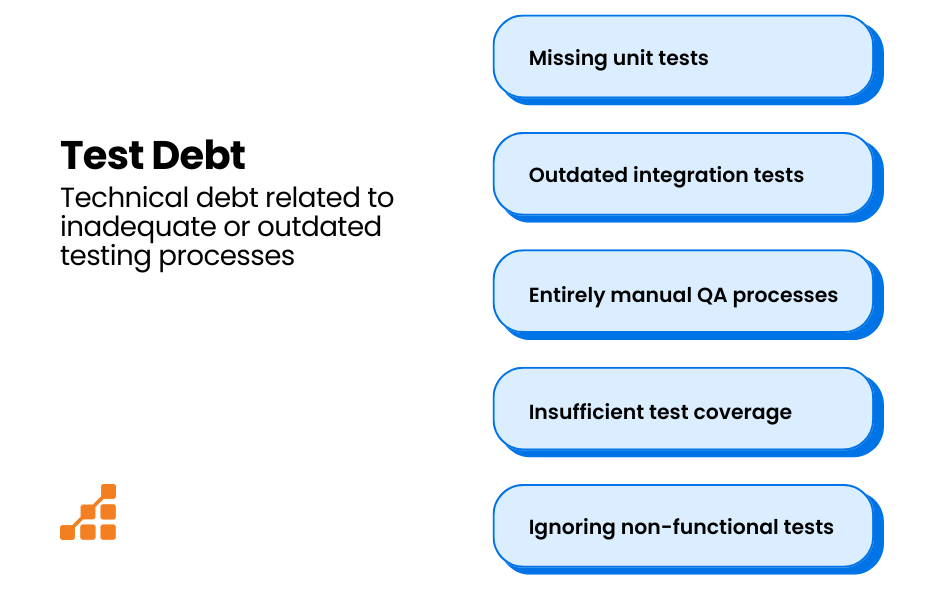
Inadequate testing is another form of technical debt. Missing unit tests, outdated integration tests, or entirely manual QA processes increase the likelihood of bugs and slow down release cycles.
3. Process Debt
Manual, inefficient processes not only slow down development but also increase the risk of human error. Without automation or efficient tools, teams often fall into a cycle of fixing issues that could have been avoided.
4. Knowledge Management (Documentation Debt)
Lack of proper documentation can be a hidden form of debt. When key individuals hold critical knowledge, and no documentation exists, your team becomes vulnerable if those individuals leave.
The Impact of Technical Debt: Consequences for Dev Teams
Unchecked technical debt can create a range of problems for both your product and your team, which only grow more complex as time passes. While some teams are able to manage technical debt in the short term, over time, it inevitably has consequences.
The impacts are far-reaching, affecting security, productivity, and even team morale.
A few of the key consequences to consider are:
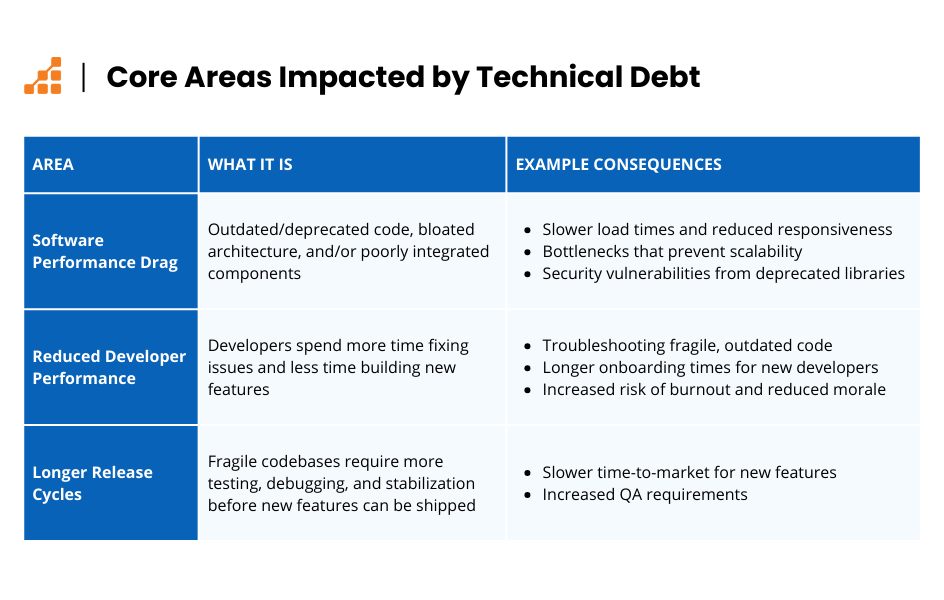
- Software Performance Drag
- Reduced Developer Performance
- Longer Release Cycles
Let’s explore these in more detail below.
Software Performance Drag
When technical debt piles up, the first noticeable impact is often on the performance of your application. Outdated code, bloated architecture, or poorly integrated components can slow down load times, reduce responsiveness, and make the user experience frustrating. This not only alienates users, but also affects the scalability of your product.
As your application grows, technical debt exacerbates bottlenecks, making it harder to handle larger traffic loads or more complex features without introducing further inefficiencies.
For example, using deprecated libraries might not cause immediate failures, but they can gradually degrade performance as they no longer receive optimizations or bug fixes. What’s worse, these libraries often introduce security vulnerabilities over time, increasing the risk of breaches that could tarnish your product’s reputation.
Reduced Developer Performance
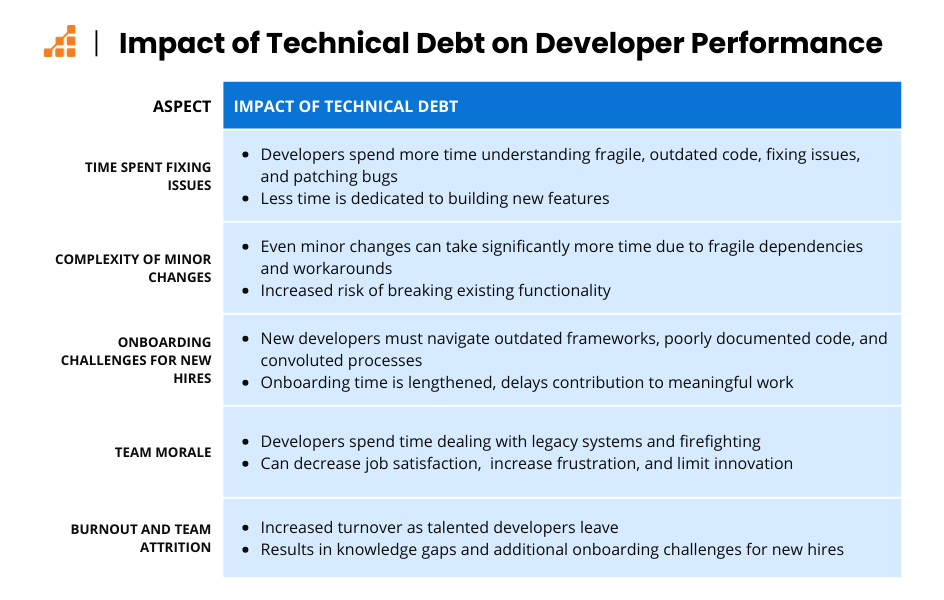
Technical debt doesn’t just impact your product—it also puts a strain on your developers. When large portions of the codebase are fragile, outdated, or full of workarounds, your developers spend more time trying to understand confusing code, fixing issues and patching bugs than creating new features. The effort it takes to troubleshoot legacy systems slows productivity, and it becomes increasingly difficult to make even minor changes without breaking something else.
For new developers joining the team, technical debt adds to their onboarding time. Instead of diving into meaningful feature work, they need to learn the intricacies of outdated frameworks, poorly documented code, and convoluted processes. This drags down morale and can cause frustration as they spend more time firefighting than innovating. Over time, this performance drag can lead to developer burnout, with some talented team members even leaving due to the compounding frustration of working in a codebase riddled with debt.
Longer Release Cycles
Another consequence of unchecked technical debt is slower release cycles. Every time you want to ship a new feature, technical debt creates more hoops to jump through. Because your codebase has become more fragile, there’s a greater risk of introducing bugs or breaking existing functionality with new updates. This means more time spent testing, debugging, and stabilizing the code—time that could have been used to innovate or address customer needs.
The increased risk also demands more extensive QA, with teams needing to patch issues that arise from the interconnectedness of outdated systems. This makes it harder to deliver new features quickly, which could hurt your product’s competitive edge. Worse still, when deadlines are tight, teams may rush deployments, leading to even more technical debt down the line, creating a vicious cycle of patches and quick fixes.
Common Causes of Technical Debt
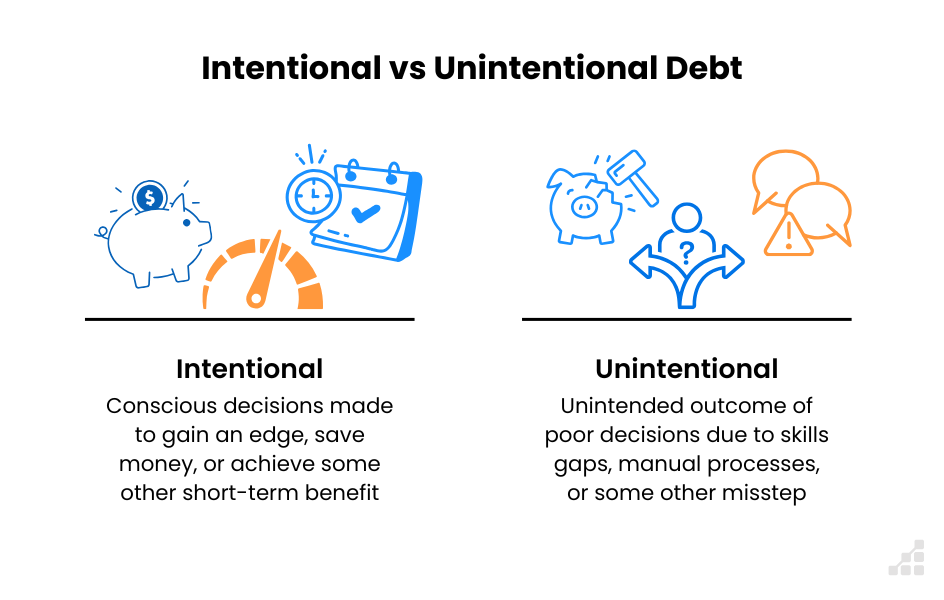
Technical debt can result from various factors – some intentional, some unintentional. While some debt is a calculated decision, other times it stems from external factors or unanticipated challenges. Understanding the causes (and impacts) helps determine when to accept it and when to address it.
Below are some common causes, along with insights on how you can manage these trade-offs. We’ll organize it by intentional and unintentional debt.
Intentional Debt
In fast-moving environments, teams often choose to incur technical debt deliberately in order to meet short-term business goals. For instance, a startup aiming to capture market share quickly may opt to ship a new feature with less-than-perfect code, with the intention of refactoring it later. This can be a strategic decision, particularly in early-stage companies where time-to-market can determine success.
Intentional technical debt isn’t always a bad thing—if it’s planned and monitored carefully. Make sure to document these decisions so that both the development and business teams are aligned on the trade-offs being made.
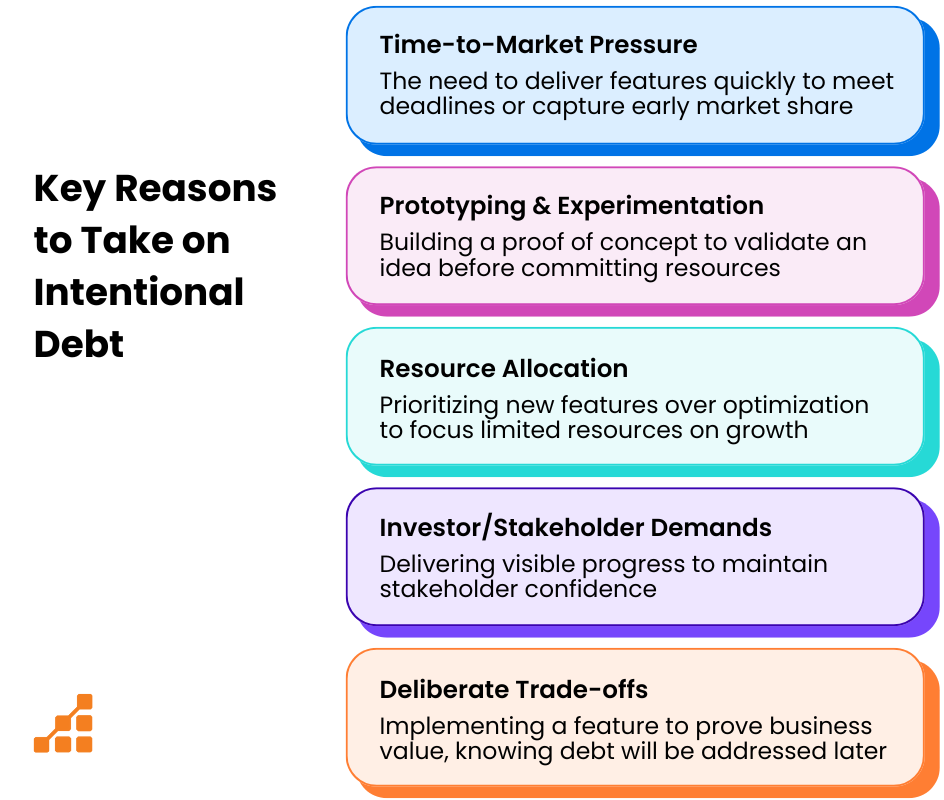
Some key reasons for taking on intentional technical debt include:
- Prototyping and Experimentation: Building a proof of concept to validate an idea before committing resources to optimize the codebase.
- Resource Allocation: Prioritizing new features or functionality over optimization to focus limited resources on growth.
- Meeting Stakeholder or Investor Demands: Delivering visible progress to maintain stakeholder confidence, even if it means accepting some compromises in code quality.
- Deliberate Trade-offs for Competitive Advantage: Choosing to implement a feature sooner, knowing that technical debt will be addressed once business value has been proven.
Key takeaway: Make sure that intentional technical debt is part of a broader strategy, not just a reactive decision. Ensure it’s revisited before it starts to slow the team down.
Unintentional Debt
1. Poor Technology Decisions
Choosing a technology that doesn’t scale well or becomes obsolete can create significant technical debt. For example, selecting a framework because it offers short-term ease of use, without considering its long-term scalability or support, can lead to painful migrations later on.
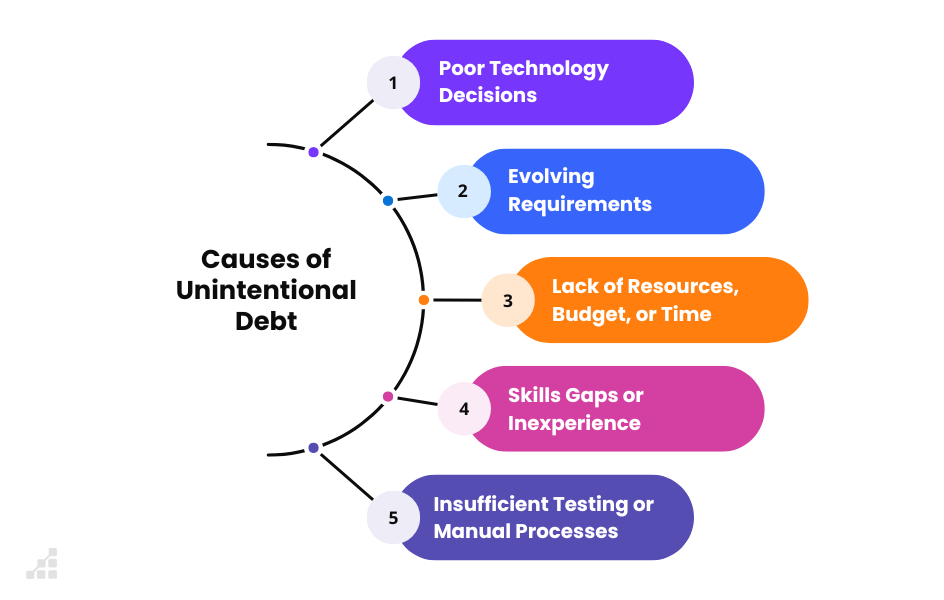
A few of the main reasons for this kind of technical debt include:
- Choosing a solution based on familiarity or development speed: teams select what they know (or what’s fastest) instead of carefully evaluating long-term needs.
- Skills gaps: junior team members might prioritize tools that are easy to learn without considering future scalability or maintainability. This can also happen when developers are working in areas where they’re less experienced, regardless of their seniority.
- Inadequate communication: communication challenges between designers, developers, and business teams can cause crucial information to be misunderstood, incomplete, or even missed entirely.
Key takeaway: Invest time in thorough evaluations of new technologies before integrating them into your stack, and favor technologies that have strong community support and a roadmap for growth.
2. Evolving Requirements/Misaligned Expectations
As a business grows and evolves, the assumptions made at the start of a project may no longer apply. What worked for your system in its early days may not meet the current needs of your customers or your business. For example, as your product adds more features or scales to support more users, code that was written to handle smaller workloads may become inefficient or unstable.
But this can also stem from misaligned expectations. If the product team expects a feature to be implemented in a certain way, but the development team has a different understanding, the solution developed might not match the needs. Misalignment can happen when requirements are interpreted differently by different teams or when priorities aren’t clearly communicated. This becomes even more problematic as the project evolves—teams might assume they’re working towards the same goal when, in fact, their understanding is diverging.
Key takeaway: Prioritize adaptable architecture and maintain a strong feedback loop between business strategy and technical implementation to reduce the impact of evolving requirements. Ensure that different teams (e.g., product, design, development) maintain open communication to avoid misaligned priorities that contribute to technical debt.
3. Lack of Resources, Budget, and/or Time
Often, teams accumulate debt simply because they lack the time, budget, or staff to address it. Small teams or resource-constrained companies tend to prioritize new features over maintaining clean code or addressing inefficiencies. Over time, this debt can compound, making it harder to implement changes without causing disruptions.
Tight timelines or pressure from stakeholders may also lead to rushed development that unintentionally introduces debt into the system, and unclear specifications can further lead to development decisions that aren’t in line with long-term needs.
Key takeaway: Even in tight resource environments, make sure technical debt is accounted for in your roadmap, and look for opportunities to automate processes to free up your team’s capacity. Implement automated deployment pipelines, improve test automation, and ensure that requirements are clearly communicated and documented to avoid the accumulation of debt due to rushed or misaligned development.
4. Insufficient Testing and/or Manual Processes
Technical debt can accumulate when there is a lack of automated testing or reliance on manual processes. Missing unit tests, outdated integration tests, and entirely manual QA practices mean issues are more likely to slip through, leading to recurring problems in production.
Key takeaway: Introduce automated testing into your development cycle, focusing on high-risk areas first. Automate repetitive workflows to reduce the risk of human error and improve efficiency.
Managing Technical Debt: Analyzing Different Approaches
Managing technical debt is not a binary choice between proactive or reactive. It’s a continuous process that requires flexibility, blending both approaches depending on the urgency of the issue, your goals, and available resources. Effective debt management is about striking a balance—tackling immediate needs while planning for long-term system health.
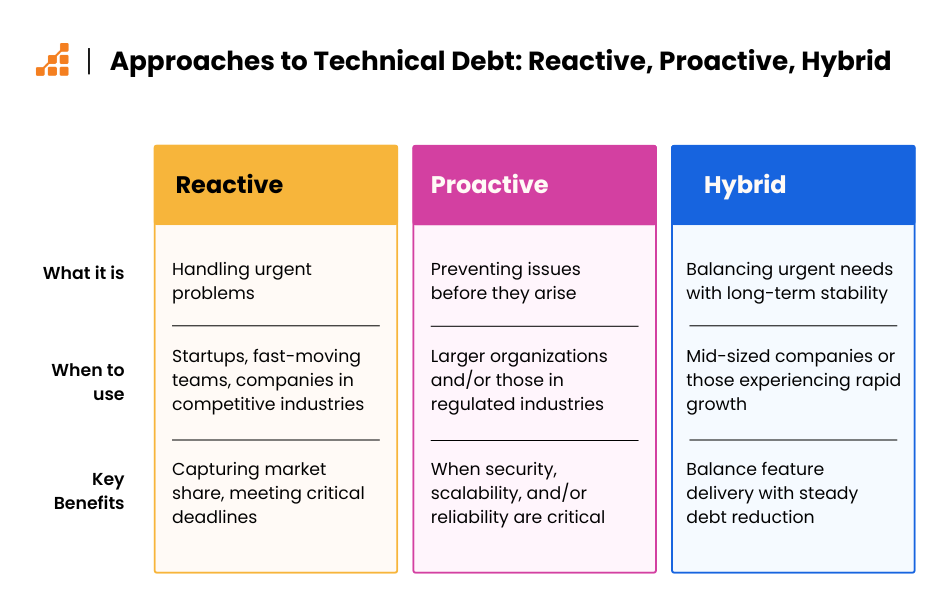
Reactive Approach: Handling Urgent Problems
The reactive approach is necessary when technical debt manifests as major issues, like bugs, security breaches, or urgent client requests. For example, an early stage startup may decide to completely ignore technical debt until their application goes down one day and they have no other choice but to deal with it. Addressing debt reactively allows teams to prioritize immediate business goals, but over time, relying solely on this can increase risks and lead to instability.
When to use: Startups and fast-moving teams may need to take a reactive approach to meet time-to-market demands. However, this comes with trade-offs, as technical risks accumulate.
How to incorporate: Even in a reactive mode, teams can mitigate long-term damage by including small refactors or documentation updates with each fix, laying the groundwork for future debt reduction.
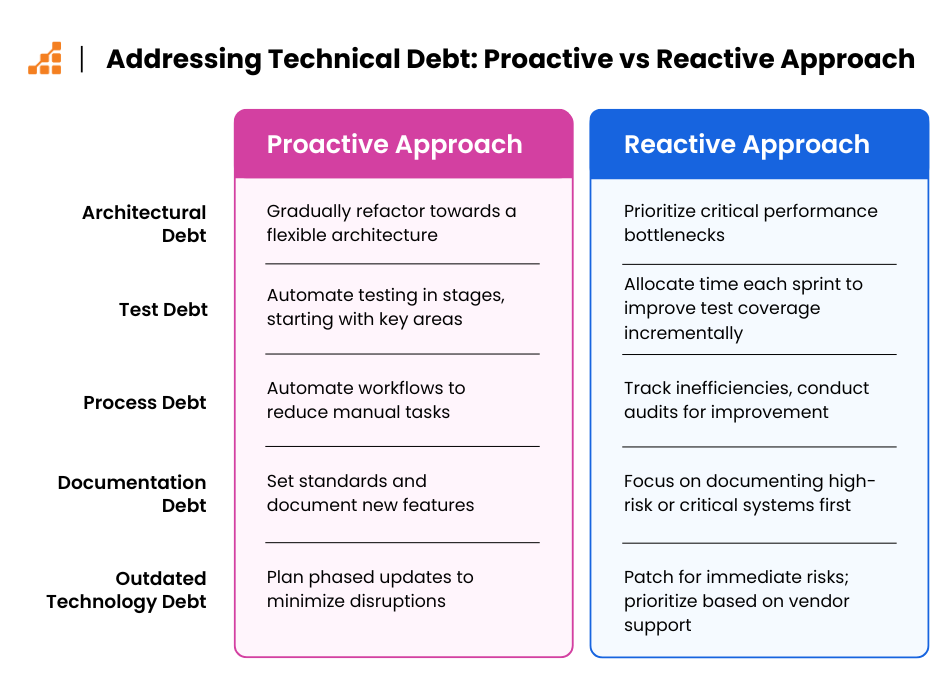
Proactive Approach: Preventing Issues Before They Arise
The proactive approach focuses on anticipating debt by regularly upgrading systems and libraries, refactoring legacy code, and improving test coverage before issues occur. This approach minimizes future risks but can be resource-intensive, especially for smaller teams. The proactive approach can be taken too far, though. For example, updating every library your application uses whenever a minor release comes out will take developers away from developing new features and can actually cause more bugs than it prevents.
When to use: Larger organizations or those in regulated industries benefit most from proactive debt management, where security, scalability, and reliability are critical.
How to incorporate: Build debt reduction into your sprints with regular refactoring or testing sprints, and invest in automation (CI/CD pipelines, automated testing) to prevent further debt from accumulating.
Hybrid Approach: Balancing Immediate Needs with Long-Term Stability
For most companies, a hybrid approach is the most practical. It combines proactive planning with reactive problem-solving, allowing teams to address immediate business needs while gradually reducing debt over time.
When to use: Mid-sized companies or those experiencing rapid growth should balance feature delivery with steady debt reduction. Allocate a portion of each sprint to addressing debt (e.g., 10-20% of developer time).
How to incorporate: Incorporate regular maintenance into your roadmap, focusing on refactoring, infrastructure and library upgrades, or testing improvements while maintaining progress on new features.
Three Steps for Managing Technical Debt
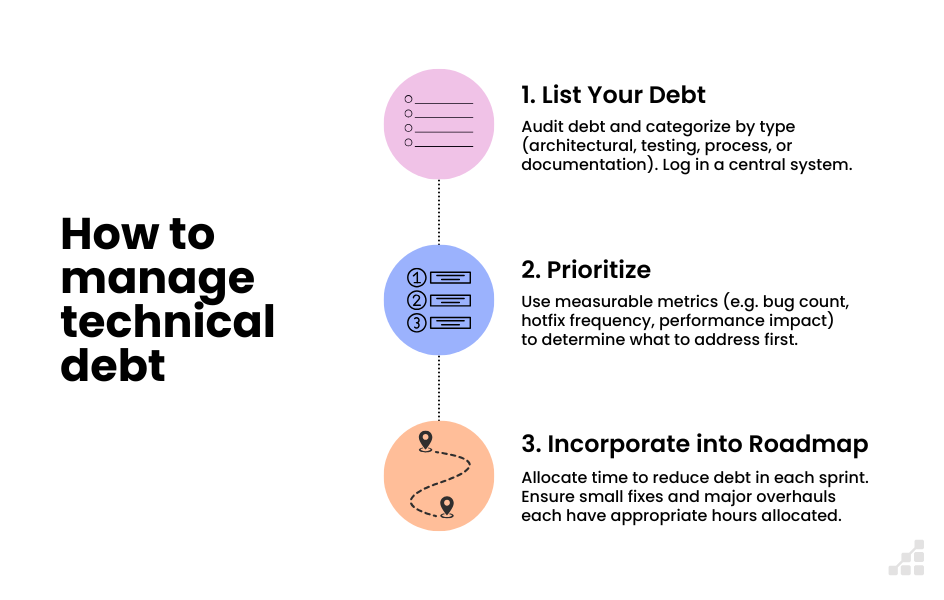
Regardless of the type of debt or the approach, these three steps will help you manage it effectively:
- List Your Debt: Track all instances of technical debt in a centralized system. Categorize by type—architectural, testing, process, or documentation—so your team can prioritize appropriately.
- Prioritize Debt: Different types of debt have varying impacts on system performance, security, and scalability. Use measurable metrics (e.g., bug count, hotfix frequency, performance impact) to determine which areas to address first.
- Incorporate into Your Roadmap: Allocate time for debt reduction in each sprint or development cycle. Different types of debt may require different amounts of time, so ensure that both incremental fixes (e.g., updating libraries) and large-scale overhauls (e.g., refactoring architecture) are planned effectively.
Scalable Path’s Approach to Technical Debt
The Early Days: Prioritizing Growth and Rapid Iteration
In the early days of Scalable Path, we almost never upgraded our application. Upgrades can be time-consuming and risky, and by minimizing them, we were able to focus on building and delivering new features fast.
Eventually, though, we found ourselves dealing with outdated versions of both Symfony and Backbone.js, both of which are no longer supported. As we grew and had more revenue, we refactored our application to Laravel and React. Now, we proactively maintain our app, though there is still tension between prioritizing debt and new feature development. This balance is essential for any growing company.
How Different Teams View Tech Debt: Insights from our Head of Engineering
It’s inevitable that different teams, departments, and individuals in a company will have differences of opinion on how to handle technical debt. Scalable Path is no exception.
So I asked our Head of Engineering, Trevor Wencl, to share his thoughts on the subject.
What’s Your Philosophy on Technical Debt?
Trevor: In my view, technical debt has direct parallels to financial debt: it’s ok to take some on from time to time to achieve certain things. Think about taking out a mortgage to buy a home. That debt can lead to possessing your most valuable asset. In most cases, that debt is worth the interest expense. But just like financial debt, you can get in over your head with technical debt, and it can cause problems down the road.
How do you Believe Technical Debt Should be Managed?
Trevor: Whenever possible, pay it down! It’s like chores that need to be done, like washing the dishes. Let them pile up and you’ll get mold and flies, and your workload will just increase. But if you take a little bit of time to deal with it regularly, paying it down a bit at a time – you won’t even really notice it in the moment.
What are the Main Challenges You’ve Experienced with Technical Debt?
Trevor: While addressing most tech debt doesn’t pose significant risk, sometimes it does. For instance, consider a major software upgrade that comes with breaking changes. This could require refactoring code, extensive QA, and pose a higher risk of issues when deployed to production.
A second (and sometimes larger) challenge is when Product Owners or higher-ups don’t see the value in spending time to address technical debt. It’s like buying a brand-new car and driving 100,000 miles without changing the oil or replacing the windshield wipers; no one would do that.
Yet, some non-technical stakeholders struggle to understand that addressing technical debt is essential to maintaining and protecting the investment made in the software.
How Do You Encourage Your Team to Manage Technical Debt?
Trevor: I try to make it part of the culture and lead by example. I frequently address Dependabot updates, schedule in software stack updates to keep reasonably current, and discuss things in our monthly retrospectives that might improve our daily work lives.
I’ve found this is mirrored in my team: developers will often bring up improvements that I don’t see. They identify inefficiencies deep in code they’ve been working on, or things that are difficult to maintain that could be improved.
Of course, all tech debt is taken into consideration with the larger objectives at hand. I’m strategic about when and how to address debt. But I never allow it to simply be ignored.
My Take on Technical Debt as the CEO
As the CEO of the company, my view differs from Trevor’s at times. Sometimes, I’ll prioritize adding new features over addressing technical debt that does not seem urgent to me. I appreciate that our dev team is thinking about technical debt, however as the Product Owner, I want to be involved in decisions on where technical debt falls into our roadmap and priorities.
If I see that the team is working on technical debt that I haven’t been consulted on while features I have requested are taking a while to finish, that can be frustrating. I also suspect that sometimes upgrades the dev team has chosen to address, cause new bugs that I find. To continue Trevor’s finance analogy: When my savings account is paying 5% interest, I’m glad I didn’t use my cash to pay down my mortgage (which is at 3%).
What Approach is Right for Your Company?
The right strategy depends on the size and stage of your company, as well as your unique risks and goals. Startups may tolerate more debt to gain market share quickly, while established companies may prioritize security and scalability.
Consider your company’s tolerance for risk, the structure of your dev team, and your industry’s requirements. Health and finance companies, for instance, will have a low tolerance for technical debt due to the sensitivity of the data they handle.
Creating a Culture of Continuous Debt Management
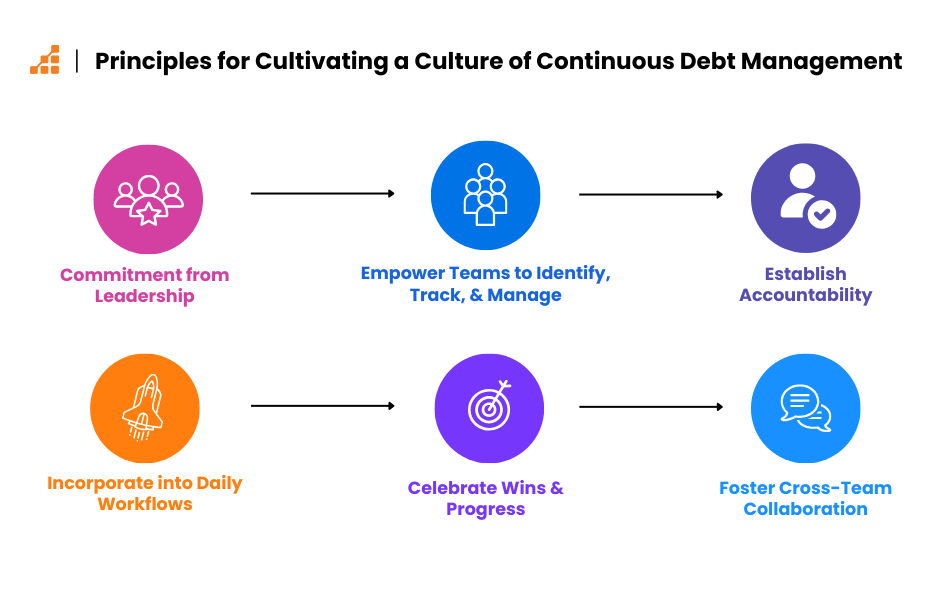
While these approaches offer distinct strategies, the key to success lies in building a culture of continuous debt management. Whether reactive, proactive, or hybrid, the focus should always be on preventing technical debt from becoming overwhelming.
Principles for Cultivating a Debt Management Culture
- Commitment from Leadership: Leaders should communicate the importance of debt management, and ensure initiatives are recognized and seen as a key component of overall success.
- Celebrate Wins and Progress: Whether it’s a significant refactoring effort, an improvement in code quality, or a reduction in maintenance time, celebrating these achievements helps to reinforce the positive behavior and motivate the team to continue these efforts.
- Foster Cross-Team Collaboration: Building a culture of continuous debt management means encouraging collaboration and transparency across all teams. When cross-functional teams work together, they can identify and resolve debt more effectively.
Final Thoughts on Technical Debt?
Technical debt is a natural part of any development process. The key is understanding how to manage it without letting it drag your company and your team down. By being intentional with your choices, regularly paying down debt, and balancing it with business goals, you can use technical debt as a tool for growth rather than a roadblock.